Unequal Distributions
North Carolina General Statute 50-20(c) lays out 12 (14 if you include subparts) factors that the court can use when determining if an equal distribution is not equitable. Here is a plain-English breakdown of what the court is actually looking for when determining whether to distribute in a manner that favors one spouse over the other
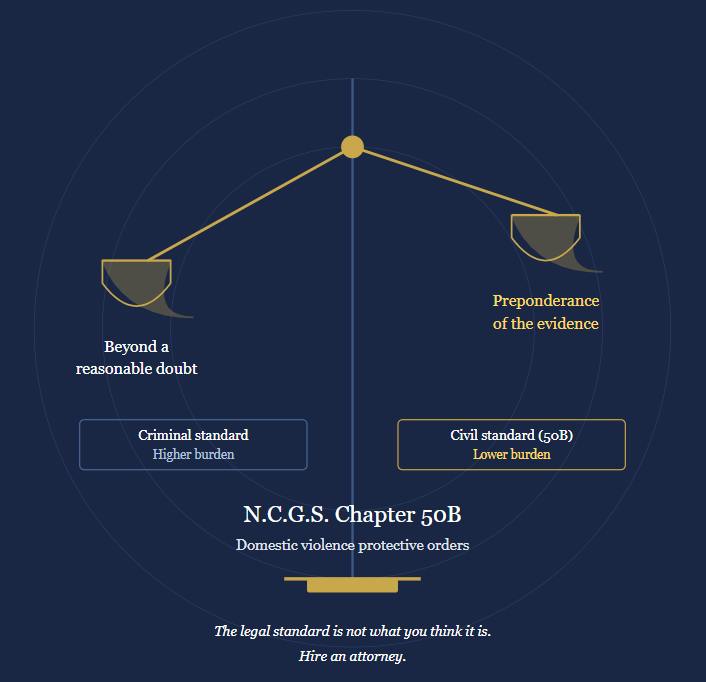
The Hidden Consequences of a 50B Order
…the petitioner only needs to show that it is more likely than not that an act of domestic violence occurred. This is a significantly lower threshold, and respondents who are unaware of this distinction are often caught off guard...
But my child said…
A child’s statements to a parent is given little weight as standalone evidence in court because these statements usually fail basic reliability and evidentiary tests. Most obviously, such statements are classic hearsay — out-of-court assertions offered to prove the truth of the matter asserted — and therefore are inadmissible unless they fall within a recognized exception.

Maturity in Custody Cases
In the eyes of the court, emotional maturity is often the single most significant indicator of a parent's ability to provide a stable home environment. Family law judges understand that separation brings intense pain, betrayal, and anger but they look for parents who can compartmentalize those feelings.

Your Personal Bank Account is not Your Personal Bank Account
In North Carolina, the division of assets during a divorce is governed by the statute of equitable distribution (N.C. Gen. Stat. § 50-20). While the objective is a fair allocation of assets and debts, a pervasive misconception often obscures the process: the belief that legal ownership (whose name is on the deed, title, or account) dictates whether an asset is marital or separate.
Understanding the Hearsay Problem
To admit such evidence into the court record, you would generally need to subpoena the therapist to testify about the diagnosis and the contents of the letter directly. The same applies to other sources, such as spouses, employers, or police officers. If they are the original source of the information, they need to be present to testify to it.
The Dangers of ChatGPT
As artificial intelligence (AI) tools become increasingly accessible and sophisticated, more individuals are turning to them to assist in drafting legal documents, especially pro se litigants, those who represent themselves in court without an attorney. These tools, including AI-based chatbots and document generators, promise affordability, speed, and simplicity in navigating the complex world of litigation.

Defense of Schizophrenia
If the person was actively psychotic or delusional during the offense, then the cause (e.g., stopping meds) might be less relevant than the effect (psychosis). However, prosecutors often argue that stopping medication voluntarily shows the person could have avoided the psychotic episode…

Five Important Tips for Custody Cases
Work on, or improve, your emotional intelligence. Learn how to de-escalate conflict. Speak positively about the other parent when around the children. Use empathy and avoid apathy. Don’t include the children in the custody case or other adult issues – let them be kids.

Acts Inconsistent
For a non-parent, like a grandparent, to assert standing in a custody action against the parents of a child, the non-parent must prove by clear, cogent, and convincing evidence that the parents are unfit or have acted in a manner inconsistent with their protected status.

Superior Rights Doctrine
For grandparents to have been awarded custody in the first place, the court must have determined that the parent was either unfit or had acted inconsistently with their constitutionally protected parental rights. This finding would have rebutted the presumption that the parent has a superior right to custody.

Legal Desert
"Legal deserts" refer to areas where residents have limited access to legal services due to a scarcity of attorneys. In North Carolina, this issue is particularly prevalent in rural regions. These legal deserts pose significant challenges for residents who need legal assistance…

The Stages of Probate
Probating an estate is a complex task, but luckily it is broken down into some pretty simple stages. In North Carolina, the probate process typically involves seven distinct stages. If you’re going to be your loved one’s representative in North Carolina, understanding these stages can provide clarity…

DVPO and Abuse of Process
The man alleges an act of domestic violence and obtains an order granting him possession of the home and no contact from the woman. He has essentially taken the woman’s residence out from under her. And this is more common than you might think!